Feed your kitten a complete food labeled for the “growth” life stage, offer 3 to 4 small meals a day until around 6 months, then drop to 2 meals a day. Weigh your kitten weekly and adjust portions based on body condition rather than the bag’s chart alone. That’s the entire system. Everything else in this guide just fills in the details.
TL;DR:
- Most kittens need 3 to 4 small meals daily from 8 weeks to 4 months, then 3 meals until 6 months, and 2 meals afterward, with portion adjustments based on weight.
- Commercial kitten food labeled for growth or all stages must meet strict nutrient ratios, especially for protein, fat, taurine, calcium, phosphorus, and DHA, which are vital for proper development.
- Regular weighing, ideally weekly, helps monitor growth and prevent overfeeding, with a focus on the body condition score rather than relying solely on the feeding guide.
- Transitioning to adult food should be gradual over 8 to 10 days, combining new and old formulas, with adjustments made based on stool quality and growth rate.
- Hydration is critical, so wet food is strongly recommended during the critical growth phase, and fresh water should always be available to prevent dehydration.
Table of Contents
- What Is the Right Kitten Feeding Schedule by Age?
- What Should You Feed a Kitten for Healthy Growth?
- How Much Food Does a Kitten Actually Need?
- When Should You Switch to Adult Cat Food?
- How Do You Prevent an Overweight Kitten?
- Practical Feeding Tips for Fussy or Struggling Eaters
- How Walnut Creek Pet Supports Healthy Kitten Growth
- Do Kittens Get Food Allergies?
- What Do Nutritional Deficiencies Look Like in a Kitten?
- Should You Give Your Kitten Supplements?
- How Much Water Does a Kitten Need Each Day?
- Why Most Kitten Feeding Advice Misses the Point
- How Walnut Creek Pet Can Round Out Your Kitten’s Diet
- Sources
What Is the Right Kitten Feeding Schedule by Age?
A newborn or very young orphaned kitten needs bottle feeding every 2 to 3 hours around the clock, a job best handled with a vet’s guidance since the formula and technique matter as much as the timing. Most kittens never reach your hands at that stage, though. What you’ll actually manage starts around weaning.
Weaning typically begins between 3 and 5 weeks of age, when kittens start showing interest in mushy solid food alongside nursing. By roughly 8 weeks old, most kittens are fully weaned and eating solid food exclusively. This is the age range where your feeding schedule kicks in for real.
Here’s how meal frequency should shift as your kitten grows:
- 8 weeks to 4 months: Feed 4 small meals a day. Kittens this young have tiny stomachs and burn through energy fast, so frequent meals prevent blood sugar crashes and support steady growth.
- 4 to 6 months: Drop to 3 meals a day. Growth is still rapid, but your kitten’s stomach capacity has increased enough to handle slightly larger portions less often.
- 6 months and older: Transition to 2 meals a day, a schedule most cats keep for life. Most kittens under 6 months need 3 to 4 small meals daily, so this drop to twice daily is a genuine milestone, not an arbitrary cutoff.
Free feeding (leaving dry food out all day) works for some very active young kittens who self-regulate well, but it’s risky once a kitten passes 6 months and activity levels start to even out. If you go free-choice early on, plan to switch to scheduled meals before your kitten’s first birthday.
What Should You Feed a Kitten for Healthy Growth?
Check the label before anything else. In the United States, pet food must carry an AAFCO nutritional adequacy statement confirming it’s formulated for “growth” or “all life stages” (which must also meet growth requirements to carry that label). That one line on the back of the bag matters more than any marketing claim on the front.
Once you’ve confirmed the growth statement, look for these nutrients doing the heavy lifting:
- Protein, ideally from named animal sources like chicken or salmon, since kittens need roughly twice the protein density of adult cat food.
- Fat, which supplies the concentrated energy growing kittens burn through fast.
- Taurine, an amino acid cats can’t synthesize in sufficient amounts and that’s essential for heart and eye function.
- Calcium and phosphorus in balanced ratio, critical for proper bone development during rapid skeletal growth.
- DHA, an omega-3 fatty acid tied to brain and vision development, often naturally present in fish-based formulas.
Quick fact: Kittens need roughly double the calories per pound of body weight that adult cats require during their first six months of life, which is exactly why an adult formula falls short during this stage.
Ingredient lists can mislead you. Terms like “premium” or “natural” aren’t regulated the way the AAFCO statement is, so a shorter ingredient panel doesn’t automatically mean a better formula. Commercial kitten food remains the safer default for most owners because homemade diets are frequently deficient in calcium, taurine, or specific vitamins unless a veterinary nutritionist designs the recipe. If you’re drawn to homemade kitten food recipes, treat that interest as a conversation to have with your vet, not a project to start solo.
How Much Food Does a Kitten Actually Need?
Start with the feeding guide printed on the bag or can, but treat it as a rough draft, not a final answer. Individual kittens vary in energy needs significantly depending on activity level, metabolism, and breed. A kitchen scale is recommended to measure food accurately instead of relying solely on measuring cups, as dry kibble density can vary.
Here’s a practical framework for building your daily routine:
- 8 weeks to 4 months: 4 meals a day, portioned to the higher end of the package guide, then adjusted after your first weigh-in.
- 4 to 6 months: 3 meals a day, watching for steady (not explosive) weight gain week over week.
- 6 to 12 months: 2 meals a day, tapering portions slightly as growth slows heading toward adulthood.
Weigh your kitten once a week on the same scale, at the same time of day if possible, and log the number somewhere you’ll actually check it. The Waltham kitten growth charts give you a percentile curve to compare against, similar to a pediatric growth chart for babies. If your kitten’s weight is climbing faster than the curve suggests, trim portions by around 10 percent and recheck in a week. If growth stalls or the kitten seems constantly hungry and lethargic, that’s a call-your-vet moment, not a wait-and-see one.
Pro Tip: Buy a $15 digital kitchen scale and weigh dry food in grams instead of using the scoop that came with the bag. Scoops compress unevenly, and a 20 gram difference per meal adds up to a real calorie surplus over a month.
When Should You Switch to Adult Cat Food?
Most kittens are ready to transition to adult food somewhere between 9 and 12 months old, once skeletal growth has mostly finished. Large-breed cats, including Maine Coons, sometimes benefit from staying on a growth formula slightly longer since their frames keep developing past the one-year mark, so ask your vet about timing if you’ve got a big-boned kitten on your hands.
Whenever you make the switch, don’t do it overnight:
- Days 1 to 3: Mix in about 25 percent adult food with 75 percent kitten food.
- Days 4 to 7: Move to a 50/50 blend.
- Days 8 to 10: Shift to 75 percent adult food, 25 percent kitten food.
- Day 10 onward: Serve 100 percent adult formula, watching stool quality along the way for signs the gut needs a slower pace.
If your kitten is spayed or neutered during this window, expect metabolism to slow afterward. That’s the moment to recalculate portions rather than assume the old amount still fits.
How Do You Prevent an Overweight Kitten?
Obesity risk starts earlier than most new owners assume. A kitten that consistently gets more calories than it burns lays down fat cells during this growth window that can predispose it to weight problems for life, which is part of why veterinary guidance favors steady growth over maximal growth.
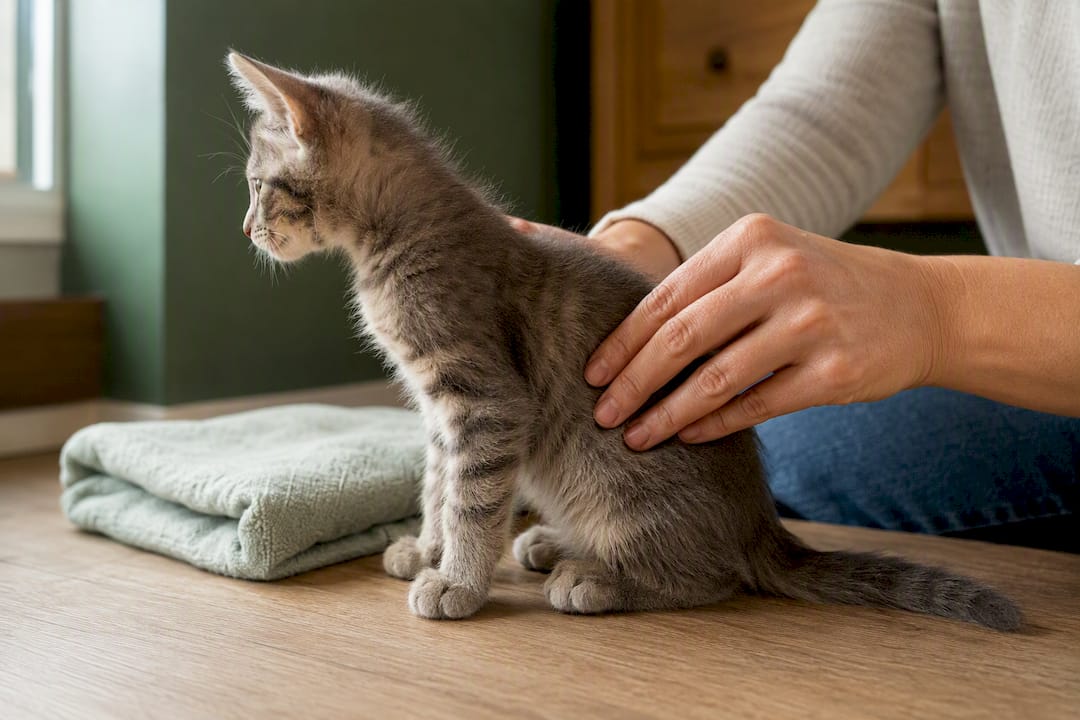
Body Condition Score (BCS) is the tool to lean on alongside the scale. Run your hands along your kitten’s ribs: you should feel them easily under a thin layer of fat, without them poking out sharply or disappearing under padding. A visible waist behind the ribs when viewed from above is a good sign; a kitten that looks like a furry loaf from that angle probably needs a portion cut.
Quick fact: Switching from free-choice feeding to portion-controlled meals around 4 to 6 months is one of the highest-leverage moves you can make, especially timed around spay or neuter, since post-surgical metabolic changes make rapid weight gain far more likely.
A few habits keep this manageable:
- Weigh food, don’t eyeball it, especially once you’re past the free-choice stage.
- Skip the growth-formula temptation to “keep the bowl full” once your kitten hits 6 months.
- Recheck portions every time your vet notes a jump on the scale between visits.
Practical Feeding Tips for Fussy or Struggling Eaters
Small adjustments solve most feeding hiccups before they become real problems. Serving wet food at room temperature, rather than straight from the fridge, boosts the aroma cats rely on to find food appetizing, and a few seconds of warming can turn a refused bowl into an emptied one.
- Rotate textures (pâté, shredded, minced) early so your kitten doesn’t fixate on one format and panic when it’s unavailable.
- Count treats toward the day’s total calories, since even small snacks add up fast in an animal this size.
- If teething makes crunching kibble uncomfortable, soften it with a splash of warm water or lean on wet food for a few days.
- Feed in a quiet spot away from foot traffic, other pets, or loud appliances, since a stressed kitten eats less regardless of what’s in the bowl.
Pro Tip: If your kitten skips food for more than 24 hours, don’t wait it out. Kittens have very little fat reserve and can develop serious liver complications from even short fasting periods, so treat a full day of refusal as a same-day vet call.
How Walnut Creek Pet Supports Healthy Kitten Growth
For picky eaters or texture transitions, single-ingredient options like freeze-dried chicken breast work well as a topper without diluting a complete kitten formula’s balance. If you’re setting up for other small animals in the household too, browse the site’s care guides and product lineup, and always loop in your veterinarian for anything that looks or feels like a medical issue rather than a feeding one.
Do Kittens Get Food Allergies?
True food allergies are less common in kittens than food sensitivities, but both show up with overlapping symptoms that make them easy to confuse. An allergy involves an immune response, usually to a specific protein, while a sensitivity is more of a digestive intolerance that doesn’t involve the immune system the same way. Either one can develop even to a food your kitten has eaten without issue for weeks, since sensitization often builds up with repeated exposure.
Watch for these signs, particularly after introducing a new food:
- Itchy skin, excessive scratching, or recurring ear infections that don’t resolve with typical treatment.
- Vomiting or loose stool that shows up consistently after meals rather than as an isolated incident.
- Excessive grooming in one spot, sometimes leading to bald patches.
Chicken, fish, dairy, and beef sit near the top of the list of common trigger proteins in cats, though any ingredient can theoretically cause a reaction. If you suspect a food allergy, don’t start swapping foods randomly. A veterinarian can guide an elimination diet using a novel protein or a hydrolyzed formula, which is the only reliable way to actually identify the culprit rather than guess at it. Switching foods every time your kitten has one loose stool just makes a real allergy harder to pin down later.
What Do Nutritional Deficiencies Look Like in a Kitten?
A kitten fed a complete, AAFCO growth-labeled food rarely develops a deficiency, which is exactly why that label check matters so much. Deficiencies show up almost exclusively in kittens on unbalanced homemade diets, low-quality foods without a proper adequacy statement, or diets missing key nutrients like taurine.
The warning signs tend to cluster around a few systems:
- Coat and skin: A dull, brittle coat or flaky skin can point to insufficient fat or essential fatty acids.
- Bones and joints: Bowed legs, reluctance to jump, or stiffness can signal a calcium or phosphorus imbalance during a growth window where bones are forming fast.
- Energy and behavior: Persistent lethargy, poor appetite, or slow weight gain relative to the growth curve can indicate an overall calorie or protein shortfall.
- Vision or heart concerns: Taurine deficiency, though rare on commercial diets, has been linked historically to retinal and cardiac problems in cats.
If you notice any of these, the fix usually isn’t a supplement bought off a shelf. It’s a food swap to a properly labeled growth formula and a vet visit to rule out other causes, since these same signs can also point to parasites or illness unrelated to diet.
Should You Give Your Kitten Supplements?
A kitten eating a complete food with an AAFCO growth statement generally doesn’t need supplements at all. That formula is already balanced for calcium, taurine, vitamins, and fatty acids in the ratios a growing kitten needs, and adding more of any single nutrient on top can actually throw that balance off rather than improve it.
There are a few legitimate exceptions. A vet might recommend a probiotic during a stressful transition, like adoption or a food switch, to support digestion. Omega-3 supplementation sometimes comes up for kittens with dry skin or coat issues despite an otherwise good diet. And kittens recovering from illness or with a diagnosed deficiency may need targeted support under direct veterinary supervision.
The rule of thumb: never add a supplement because you read about it online or because a bottle promises better coat shine. Ask your vet first, describe exactly what you’re seeing, and let them confirm whether the food itself needs to change instead. Supplementing on top of an already-complete diet is one of the more common ways well-meaning owners accidentally create an imbalance rather than solve one.
How Much Water Does a Kitten Need Each Day?
Hydration matters more in kittens than most new owners expect, partly because kittens are notoriously bad at drinking enough water on their own. Dehydration compounds fast in a small body, and it can mask or worsen digestive upset, making an already sensitive stomach even harder to settle.
Wet food does a lot of the hydration work automatically, since it typically runs 70 to 80 percent moisture compared to roughly 10 percent in dry kibble. A kitten eating mostly wet food gets a meaningful chunk of daily water needs through meals alone, which is one reason many vets lean toward wet or mixed feeding during the kitten stage rather than dry-only.
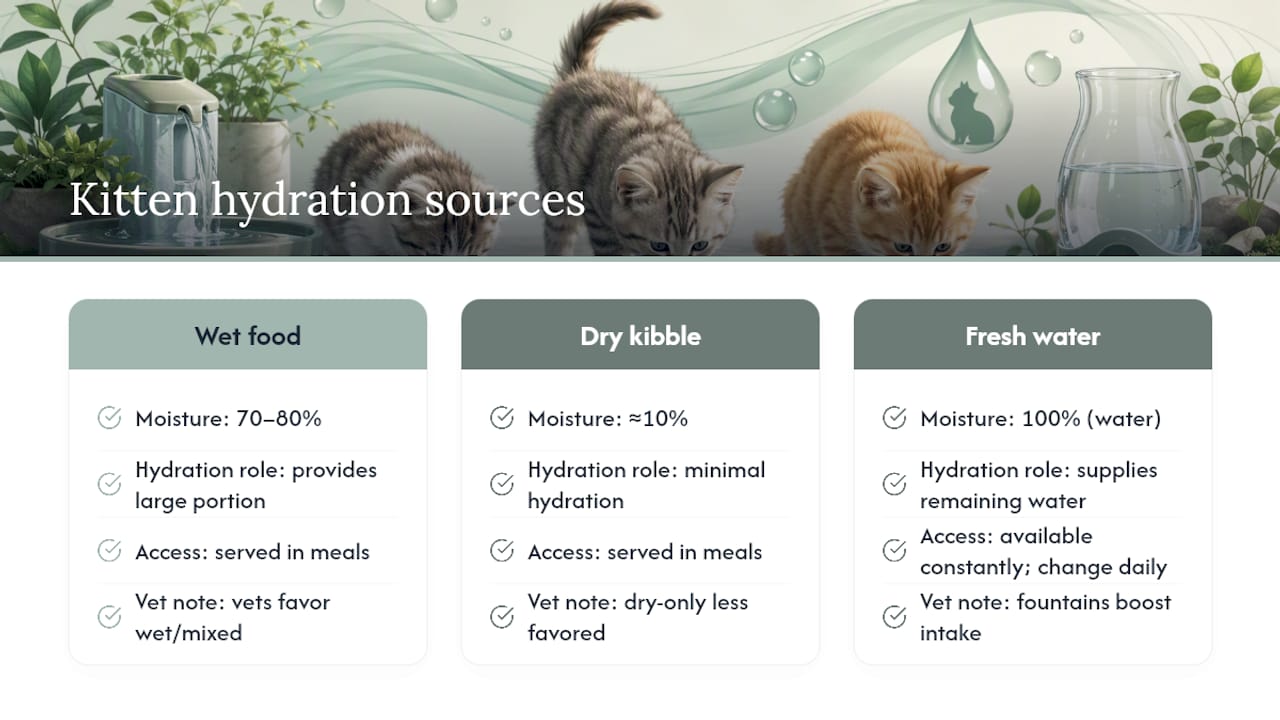
Fresh water should still be available at all times, in more than one location if your kitten is in a multi-room household. Cats in general (kittens included) prefer moving or fresh-smelling water over stagnant bowls, which explains why fountain-style water dishes tend to boost intake for cats that otherwise ignore a still bowl. Change water at least once daily, and wash the bowl regularly since a filmy bowl can put a kitten off drinking entirely.
Watch for signs of poor hydration: dry gums, skin that’s slow to spring back when gently pinched at the scruff, or noticeably less frequent urination. Any of those warrants a vet call rather than a wait-and-see approach, especially in a kitten small enough to dehydrate quickly.
Why Most Kitten Feeding Advice Misses the Point
Most kitten feeding advice fixates on brand names and ingredient panels, when the actual leverage point is monitoring, not the bag you buy. Two owners can feed the exact same food and get wildly different outcomes because one is weighing weekly and adjusting, and the other is eyeballing a scoop and hoping for the best.
The conventional wisdom oversells the “right food” decision and undersells the boring stuff: the kitchen scale, the weekly weigh-in, the willingness to cut a portion by 10 percent when the growth curve tips too steep. Any complete food carrying the AAFCO growth statement will do the job nutritionally. What separates a lean, healthy adult cat from an overweight one three years later usually traces back to whether someone was paying attention during these twelve months.
If I had to pick the single habit new owners should prioritize above all else, it’s the scale, not the food aisle. Buy the food that meets the growth standard, then spend your actual attention on tracking trajectory. That’s where the real outcome gets decided.
— Timothy
How Walnut Creek Pet Can Round Out Your Kitten’s Diet
Walnutcreekpet is built for exactly this stage of pet ownership: getting a complete diet right and then filling in the practical gaps around it. Toppers and single-ingredient treats aren’t a replacement for a properly balanced kitten formula, but they’re genuinely useful tools for easing a fussy eater into a new food or adding variety without wrecking nutritional balance.
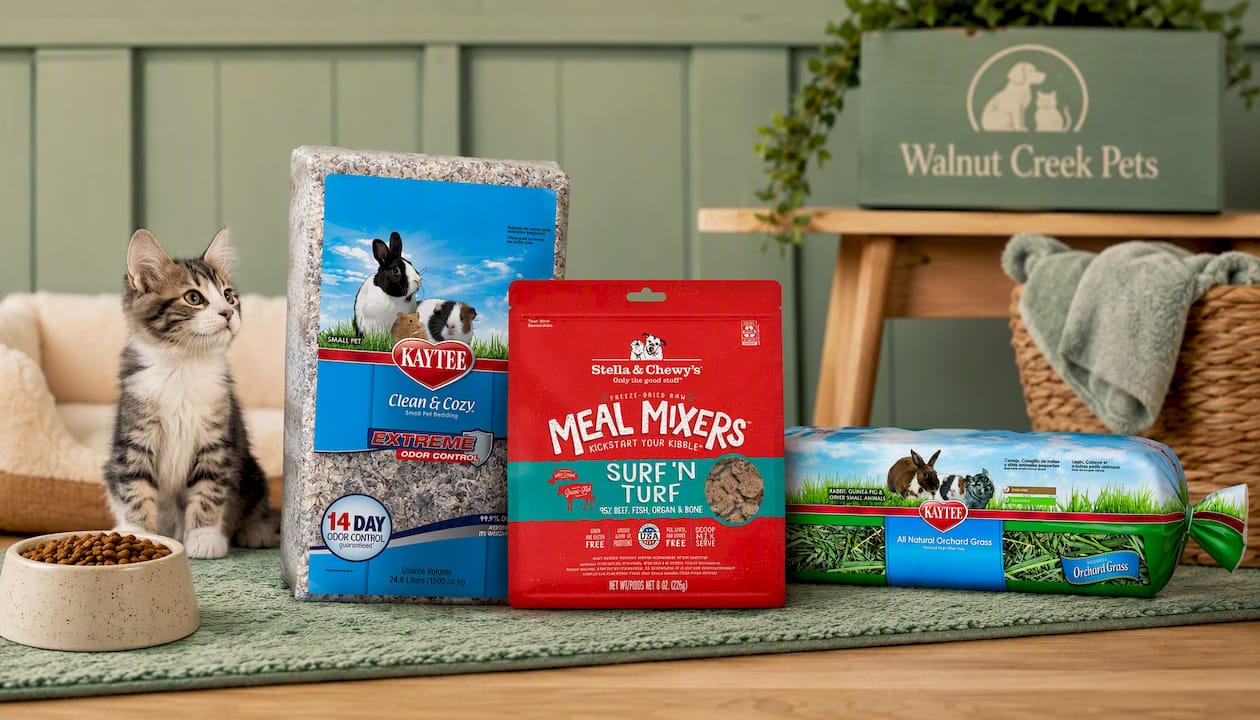
If you’re managing a multi-pet household during this transition, Stella & Chewy’s Freeze Dried Meal Mixers Surf & Turf shows how a freeze-dried meal mixer can boost palatability as a topper across species in the home. Small animal households rounding out their setup can check out Kaytee Clean and Cozy Small Animal Bedding for odor control, and Kaytee Orchard Grass treats for a single-ingredient snack option. Browse the kitten and cat product lineup to build out your feeding setup before your kitten’s first big growth spurt hits.